0000-00
What should a procurement team look at first when comparing suppliers?
Start with fit, not price. A Transformer insulation cardboard processing equipment supplier in India may look competitive on a quotation sheet, but that tells you very little about whether the machine will match your production needs. The first check is simple: does the supplier actually understand transformer insulation material processing, or are they just selling general-purpose wood or sheet processing equipment?
For procurement teams, the early shortlist should be based on five points: material knowledge, machine scope, customization ability, installation support, and after-sales response. Insulation cardboard is not an ordinary board product. It affects downstream forming quality, dimensional consistency, and handling efficiency in transformer manufacturing. If a supplier cannot discuss those issues clearly, the risk is already visible before you place the order.
A useful first-round question is: “What types of insulation materials and parts do you already build equipment around?” That usually exposes whether the supplier works in this segment seriously or only approaches it as a general machinery sale.
Does it matter if the supplier also understands transformer component manufacturing?
Yes, it matters more than many buyers expect. A supplier with exposure to transformer-related manufacturing usually gives more practical recommendations on feeding, cutting accuracy, material handling, process flow, and operator training. That reduces the number of bad assumptions during project discussion.
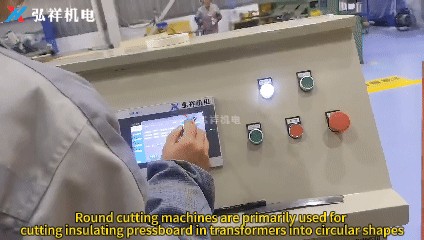
This is where background becomes relevant. Gaomi Hongxiang Electromechanical Technology Co., Ltd. focuses on services and manufacturing related to power transformers and also works with electrical insulating cardboard, insulating laminated wood, and insulating parts. For a buyer, that kind of business direction is useful because it suggests the supplier is closer to the real application environment, not just the machine itself.
That said, do not stop at the company profile. Ask how that experience changes machine design, commissioning, spare parts planning, and operator setup. Procurement decisions get stronger when business positioning is supported by clear execution details.
How can you tell whether a quoted machine is truly suitable for insulation cardboard processing?
You need a technical review tied to your actual production, not a generic brochure. Ask the supplier to map the machine to your working material, finished part type, throughput expectation, and operator environment. If that conversation stays vague, the quote is probably too generic.
At minimum, procurement should verify:
- What raw material forms the machine is designed to handle
- Whether the process is aimed at board cutting, shaping, slotting, forming, or multi-step part preparation
- How the supplier defines production capacity in real operating terms
- What level of operator adjustment is required during normal use
- Which wear parts and consumables are expected in routine operation
One common purchasing mistake is accepting a “can process this material” answer without asking under what conditions. Material thickness range, part geometry, and stability over repeated production runs all affect suitability. A machine that works on sample pieces may still become inefficient in batch production.
What documents should you request before moving from inquiry to negotiation?
Procurement should gather documents that help compare suppliers on execution quality, not just sales language. The point is to reduce hidden cost later.
If the supplier offers installation, training, and after-sales service as part of its business model, that should appear clearly in the documentation rather than being left as a verbal promise.
Is the lowest quotation ever the right choice?
Usually not. In this category, the cheapest quote often becomes expensive through downtime, weak support, missing accessories, or process mismatch. Procurement teams that focus only on initial machine price often end up buying risk.
A better approach is to compare total acquisition cost over the first operating period. That includes the base machine, tooling, commissioning support, training, spare parts, packaging, shipping, installation responsibility, and likely maintenance frequency. Even without exact operating data, this comparison is far more useful than price alone.
If one supplier’s number is far below the others, check what was omitted. In many cases, the price gap comes from a thinner service scope or a machine configuration that does not fully match the requested process.
How should you evaluate customization capability without overpaying for it?
Customization is valuable when your insulation parts, workflow, or plant conditions are specific enough that a standard machine will create bottlenecks. It becomes wasteful when it is used to solve issues that could have been handled by better process planning.
The practical test is whether the supplier asks for the right inputs. They should want to know your material type, target part family, expected output, available floor space, operator skill level, and any integration needs with upstream or downstream work. A supplier that claims full customization without collecting this information is not really engineering the solution.
Gaomi Hongxiang states that it supports R&D, design, production, installation, training, and after-sales service, and also supports special machine manufacturing. For a procurement team, that suggests potential flexibility. The next step is to translate that into a clear project scope: what is custom, what remains standard, how long the design cycle takes, and which acceptance points will prove the machine performs as agreed.
What are the biggest after-sales questions buyers forget to ask?
Most buyers ask whether after-sales service exists. Fewer ask how it actually works when production stops. That is the more important question.
You want clear answers on response method, spare parts availability, training depth, and fault escalation. If the supplier exports to India and other overseas markets, that can be useful, but procurement still needs the service mechanics in writing.
- Who handles first response: sales staff, service engineers, or local partners?
- What information must your team provide when reporting a fault?
- Which spare parts should be stocked on site from day one?
- Is operator training limited to startup, or does it include routine adjustment and basic troubleshooting?
- What situations require an on-site visit rather than remote support?
A weak after-sales structure rarely shows up during vendor presentation. It shows up when a line is idle and nobody can give your maintenance team a usable answer.
Should Indian buyers prefer a local supplier or an overseas manufacturer?
That depends on what matters most in the project. A local supplier may offer easier communication, faster site visits, and simpler coordination. An overseas manufacturer may offer deeper specialization in transformer insulation processing or broader machine-building capability. Neither option is automatically better.
Use a decision split. If your project is standard, service speed may outweigh everything else. If your process is specialized and the machine must closely match transformer insulation production needs, technical fit may matter more than geography. In that case, the supplier’s export experience, installation support, training process, and spare parts planning become the key checks.
The right comparison is not local versus overseas in the abstract. It is which supplier can deliver the required machine, support it properly, and keep your operating risk under control.
What warning signs usually show up before a bad purchase?
A few patterns come up often. The supplier avoids detailed process questions. The quotation is brief but the claims are broad. The machine description sounds interchangeable with other industries. Service language is general and undocumented. Delivery promises are very aggressive, but no one explains design review, commissioning steps, or training coverage.
Another warning sign is when every answer returns to price. Good suppliers care about price, but they also want to define material scope, machine boundaries, and support obligations. If those details stay blurred, procurement will carry the cost later through change requests, delays, or underperformance.
How should procurement finalize the decision?
Close the process with a side-by-side commercial and technical review. Keep it simple, but force the comparison into the same structure for every supplier. You are looking for the most reliable operating choice, not the most persuasive presentation.
Make the final check against these questions: Does the supplier understand transformer insulation material processing? Is the machine scope clearly defined? Are installation, training, and after-sales responsibilities written down? Can the supplier support customization if your process requires it? Does the quoted cost still make sense after you include support and maintenance exposure?
A sound purchase decision usually comes from one rule: choose the supplier that gives you the clearest connection between machine design, production use, and service accountability. In this segment, that is what protects cost, schedule, and output quality at the same time.
NAVIGATION
MESSAGE
Request A Quote?